
Thursday, August 5, 2010
Our bags are packed, our bellies are full, and our wallets are EMPTY! We checked out of the hotel this morning and did some last-minute shopping in the city.
We made a quick stop for a Bloody Mary at the Old Biscuit Mill, which is now converted into a little shopping center. Then we went to an area called St. George's Mall, where there are many street vendors selling crafts, vuvzelas, and other World Cup gear. After buying our final souvenirs, we had lunch at Nando's--our favorite African (it's actually Portuguese) fast food restaurant.
We made one final walk down Long Street, back to our hotel. Now we're just killing some time, checking emails and Facebook, while we wait for our taxi to the airport.
The past four weeks have been such an amazing experience for both of us, full of wonderful people, food, and memories. We hope our friends and family have enjoyed reading this blog as much as we have enjoyed sharing our journey. We are scheduled to leave Cape Town Thursday afternoon and to arrive in Los Angeles on Friday evening. We are praying that we have uneventful flights and that there is no drama to deal with, unlike our flights coming to Africa. Although we will miss Africa and our new friends here, we are both looking forward to seeing our old friends and our families, as well as sleeping in our own beds.
So long Africa! We hope to see you again some day.
Thursday, August 5, 2010


Wednesday, August 4, 2010
Robben Island and the Waterfront
Wednesday, August 4, 2010
We started the day with another fabulous breakfast buffet at our hotel, then we walked to the V&A Waterfront to get on the boat to Robben Island. For those of you who don't know, Robben Island is where Nelson Mandela and hundreds of other political prisoners were kept during South Africa's Apartheid Era. The island is 12 kilometers off the coast of Cape Town, and it was originally a leper colony before being converted to a maximum security prison facility. The prison is now a museum, with former prisoners giving the guided tours.

Doug has been anxiously awaiting this part of the trip because he recently finished Mandela's autobiography "Long Walk To Freedom." This is a very long and detailed book, but also an excellent story for anyone interested in the life of Nelson Mandela and the struggle for equal rights in South Africa. Seeing the island, the prison, and Mandela's prison cell really brought the book to life.
When we arrived on the island, we were given a 45-minute bus tour. We saw the lime quarry where Mandela and other prisoners worked for 13 years. While they worked here, they also held many political discussions (while the guards weren't watching), and many say that this is where South Africa's new government was actually formed. There is a rock pile at the entrance of the quarry which was put there in 1995, four years after the last political prisoners were released from the island. At a reunion of thousands of political prisoners who had spent time there, Mandela placed a single rock on the ground. Without any previous planning or speaking a word, all the other reunion attendees followed suit and created the rock pile, which hasn't been touched since 1995.

The bus drove us through the island's village, where around 100 people live. The tour guides (former prisoners) live on the island with their families, along with former guards and other employees of the museum. Our tour guide said that his neighbor is a former guard and they have become good friends and gotten over the past. There is an elementary school with 13 students and three teachers, with a 100% passing rate. With class sizes rising in the Burbank schools, this student to teacher ratio made us very jealous.

We made a quick restroom and refreshment stop at a place along the island's beach where we could see Table Mountain and the surrounding peaks. After a few pictures, we got back on the bus and were taken to the prison for our tour.
At the prison, we were shown some of the larger cells where regular prisoners and political prisoners, who were considered less dangerous, were kept. These cells were large enough to hold 60 prisoners in one room with bunk beds, along with a separated room for showers and toilets. Our guide explained how only non-white prisoners were kept at Robben Island. The blacks were treated much worse than the Indian and Colored (mixed race) prisoners--this was one of the many ways the prison authorities tried to psychologically demoralize the prison population. Black prisoners were made to wear shorts and short-sleeved shirts, even in winter, while Indian and Colored prisoners got full-length pants, long-sleeved shirts, and jackets. Black prisoners also received smaller portions during meals, and their food was not as good.

We walked around to see a few other areas of the prison, including the tennis courts and football (soccer) field where the prisoners were allowed to exercise of Saturdays. Eventually we where taken to Block B, where Manela and other "dangerous" political prisoners were kept in solitary cells. We got to look inside Mandela's cell, which is approximately 6 feet deep and 6 feet wide, barely large enough to stretch out as one lays on his sleeping mat on the floor. The cell also had a bucket that the prisoner would use to relieve himself. Otherwise, the cell had no furnishing. In later years, prisoners were given a small table if they were permitted to study.

After walking through the solitary confinement cell blocks, we were "released" back to the dock to get on our boat. The boats that are used are the same boats that transported prisoners to and from the island when the prison was still in use.
When we got back to the V&A Waterfront, we made a quick stop at Paulaner Brauhaus to taste a few of their beers. We each got the Taster Trio, 100 ml each of three of their homemade brews. Then we walked to the other side of the Waterfront to a restaurant called Cape Town Fish Market, where we had more sushi and some Kingklip fish for lunch.

After lunch, we stopped in a few of the stores along the Waterfront to shop for some traditional drum music and other souvenirs and gifts for our family and friends. We were pretty exhausted after today's activities, so we decided to catch the shuttle back to our hotel. When we got there, we took a quick nap and then packed our suitcases one last time before heading home. We managed to get everything into the suitcases (for now). We're hoping we won't have to redistribute again when we get to the airport--we're not sure what the checked bag and weight requirements are for our first flight to Johannesburg.
In the evening, we took a taxi to the other end of Long Street to check out some of the Cape Town night life. We got dropped off at an Irish pub called Dubliner, but their live music wouldn't be starting until 10:00. We decided to check out some of the other restaurants for dinner. After browsing a few different menus, we ended up at a place called the Long Street Cafe where each of us had a pizza. Next, we walked around the corner into a bar called Julep where two acoustic guitarists were performing. Of course, as soon as we walked in the door, they decided to go on a break.
From there we walked a few blocks to the Baghdad Cafe. We enjoyed a bit of hookah and a drink while talking to the bartender about how great Cape Town prices are compared to Los Angeles. We were the only customers in the bar, and as the bouncer slept on a couch, we continued to talk to the bartender about his music career and the other bars and clubs in the area.
Next we went upstairs to a bar called Zula. There was a rock band playing, and a very small old man dancing wildly to the music. The music was pretty decent, but the crowd seemed to enjoy the old man's dancing much more than the music. After a few songs we left and went back to the Julep. This time, the guitarists were playing and we sat right in front. There music was a blend of folk and rock, and it reminded us of Dave Matthews or The Barenaked Ladies. We really wished they had CDs for sale, but they didn't. The told us the name of their bands so we could try to find some of their music on Facebook.

It was midnight at this point, past our bedtimes, so we got into a taxi and went back to the hotel. We've had an excellent time in Cape Town, and we hope we have a chance to visit again some day.
This may be our last chance to post anything on the blog until we arrive back in Burbank, so don't expect any more updates for the next 48 hours.
We started the day with another fabulous breakfast buffet at our hotel, then we walked to the V&A Waterfront to get on the boat to Robben Island. For those of you who don't know, Robben Island is where Nelson Mandela and hundreds of other political prisoners were kept during South Africa's Apartheid Era. The island is 12 kilometers off the coast of Cape Town, and it was originally a leper colony before being converted to a maximum security prison facility. The prison is now a museum, with former prisoners giving the guided tours.

On the boat to Robben Island
When we arrived on the island, we were given a 45-minute bus tour. We saw the lime quarry where Mandela and other prisoners worked for 13 years. While they worked here, they also held many political discussions (while the guards weren't watching), and many say that this is where South Africa's new government was actually formed. There is a rock pile at the entrance of the quarry which was put there in 1995, four years after the last political prisoners were released from the island. At a reunion of thousands of political prisoners who had spent time there, Mandela placed a single rock on the ground. Without any previous planning or speaking a word, all the other reunion attendees followed suit and created the rock pile, which hasn't been touched since 1995.

rock pike at the quarry

Robben Island elementary school
At the prison, we were shown some of the larger cells where regular prisoners and political prisoners, who were considered less dangerous, were kept. These cells were large enough to hold 60 prisoners in one room with bunk beds, along with a separated room for showers and toilets. Our guide explained how only non-white prisoners were kept at Robben Island. The blacks were treated much worse than the Indian and Colored (mixed race) prisoners--this was one of the many ways the prison authorities tried to psychologically demoralize the prison population. Black prisoners were made to wear shorts and short-sleeved shirts, even in winter, while Indian and Colored prisoners got full-length pants, long-sleeved shirts, and jackets. Black prisoners also received smaller portions during meals, and their food was not as good.

We walked around to see a few other areas of the prison, including the tennis courts and football (soccer) field where the prisoners were allowed to exercise of Saturdays. Eventually we where taken to Block B, where Manela and other "dangerous" political prisoners were kept in solitary cells. We got to look inside Mandela's cell, which is approximately 6 feet deep and 6 feet wide, barely large enough to stretch out as one lays on his sleeping mat on the floor. The cell also had a bucket that the prisoner would use to relieve himself. Otherwise, the cell had no furnishing. In later years, prisoners were given a small table if they were permitted to study.

the inside of Nelson Mandela's prison cell
When we got back to the V&A Waterfront, we made a quick stop at Paulaner Brauhaus to taste a few of their beers. We each got the Taster Trio, 100 ml each of three of their homemade brews. Then we walked to the other side of the Waterfront to a restaurant called Cape Town Fish Market, where we had more sushi and some Kingklip fish for lunch.

After lunch, we stopped in a few of the stores along the Waterfront to shop for some traditional drum music and other souvenirs and gifts for our family and friends. We were pretty exhausted after today's activities, so we decided to catch the shuttle back to our hotel. When we got there, we took a quick nap and then packed our suitcases one last time before heading home. We managed to get everything into the suitcases (for now). We're hoping we won't have to redistribute again when we get to the airport--we're not sure what the checked bag and weight requirements are for our first flight to Johannesburg.
In the evening, we took a taxi to the other end of Long Street to check out some of the Cape Town night life. We got dropped off at an Irish pub called Dubliner, but their live music wouldn't be starting until 10:00. We decided to check out some of the other restaurants for dinner. After browsing a few different menus, we ended up at a place called the Long Street Cafe where each of us had a pizza. Next, we walked around the corner into a bar called Julep where two acoustic guitarists were performing. Of course, as soon as we walked in the door, they decided to go on a break.
From there we walked a few blocks to the Baghdad Cafe. We enjoyed a bit of hookah and a drink while talking to the bartender about how great Cape Town prices are compared to Los Angeles. We were the only customers in the bar, and as the bouncer slept on a couch, we continued to talk to the bartender about his music career and the other bars and clubs in the area.
Next we went upstairs to a bar called Zula. There was a rock band playing, and a very small old man dancing wildly to the music. The music was pretty decent, but the crowd seemed to enjoy the old man's dancing much more than the music. After a few songs we left and went back to the Julep. This time, the guitarists were playing and we sat right in front. There music was a blend of folk and rock, and it reminded us of Dave Matthews or The Barenaked Ladies. We really wished they had CDs for sale, but they didn't. The told us the name of their bands so we could try to find some of their music on Facebook.

It was midnight at this point, past our bedtimes, so we got into a taxi and went back to the hotel. We've had an excellent time in Cape Town, and we hope we have a chance to visit again some day.
This may be our last chance to post anything on the blog until we arrive back in Burbank, so don't expect any more updates for the next 48 hours.
Tuesday, August 3, 2010
Golf and the Cape of Good Hope
Tuesday, August 3, 2010
We woke up before dawn and prepared for a morning of golf at the Rondebosch Golf Club. A taxi took us to the course, we checked in and got our rental clubs and golf cart, and the sun still wasn't up. After having a quick breakfast, there was a bit of daylight and it was our turn on the tee. We got to golf by ourselves, without being paired with another twosome, and we didn't see any other golfers for the entire front nine--it was great. The course is relatively flat, with wide fairways, and spectacular views of Table Mountain and Devil's Peak. We were amazed at how green the course was compared to the other parts of Africa we've visited, and we spent more time taking pictures of the scenery than we did focusing on our golf shots.


After our round, we got a taxi back to our hotel, where we changed shoes and socks (they were very wet from early morning golf) and got ready for our private tour of the Cape Peninsula. We had a quick lunch in the hotel restaurant, and then William, the driver who brought us to the hotel from the airport, picked us up for the tour. We told him we wanted to skip some of his usual spots and that our main priorities were the Cape of Good Hope, Cape Point, and Boulder Beach. This allowed us to negotiate the price even lower than we had originally agreed.
William first drove us to Haut Bay, where we stopped for a few minutes to enjoy the view of the nice beach and the fog rolling in from the sea. Next we drove over Chapman's Peak and through some small beach communities.

We eventually entered the Cape of Good Hope section of Table Mountain National Park, which led us down to the end of the Peninsula--Cape Point. This is the southwesternmost point of the African continent. The peninsula comes to a point as jagged cliffs, covered by quick-moving fog, drop off into the ocean. We took a bus up to the top of the hill where a very old lighthouse sits and overlooks the final peak of the coastline. We took a few pictures on the cliffs, making Doug extremely nervous, and then rode back down to continue our tour.


Next we drove up the western side of the peninsula, facing False Bay, through a few more beach towns. Our next stop was Boulder Beach, home to 3000 African Penguins. As we walked along a boardwalk and observed the penguins in the nests under the trees and along the rocky coastline, Dena exclaimed "They're so cute!" around 80 times. We wanted to pick up the tiny little creatures and take them home, but the oils from human skin are dangerous to the penguins, and their beaks are dangerous to humans.


After trying to talk to the penguins and imitate their walk for one hour, we got back into the car to continue our drive along the coast. Again, this part of the country really doesn't feel like Africa. We have to keep reminding ourselves that we are here, and not in a zoo, or Europe, or California. After driving through another stretch of beach towns, which all look like Malibu, we drove inland and back into the main City Center of Cape Town.
We thanked William for the excellent tour and got dropped off at the V & A Waterfront to have dinner. We went to an Irish brewery called Mitchell's and had some food and drinks. We finally found a place that serves Springbok shots, a drink we discovered at the Springbok Bar and Grill in Van Nuys, CA. Next we walked over to Quay Four, where we had lunch yesterday, to hear some live music. Unfortunately, their version of live music is a man and a woman singing cheesy cover songs with a soundtrack in the background. At least the man played guitar, but the woman just danced with her microphone like a Spartan Cheerleader from Saturday Night Live. We left after one drink and went to the Green Dolphin, a restaurant that has live jazz music "8 nights a weeks." Of course, as soon as we ordered our drinks, the band took a break. When they finally came back, we enjoyed 2 or 3 songs and then walked back to the hotel.

We only have one more full day left in Cape Town and Africa. We can't believe we've been here for a month, but sometimes it feels like we've been here for a year. There are so many great things on this continent, but we miss our lives back in Burbank.
We woke up before dawn and prepared for a morning of golf at the Rondebosch Golf Club. A taxi took us to the course, we checked in and got our rental clubs and golf cart, and the sun still wasn't up. After having a quick breakfast, there was a bit of daylight and it was our turn on the tee. We got to golf by ourselves, without being paired with another twosome, and we didn't see any other golfers for the entire front nine--it was great. The course is relatively flat, with wide fairways, and spectacular views of Table Mountain and Devil's Peak. We were amazed at how green the course was compared to the other parts of Africa we've visited, and we spent more time taking pictures of the scenery than we did focusing on our golf shots.


After our round, we got a taxi back to our hotel, where we changed shoes and socks (they were very wet from early morning golf) and got ready for our private tour of the Cape Peninsula. We had a quick lunch in the hotel restaurant, and then William, the driver who brought us to the hotel from the airport, picked us up for the tour. We told him we wanted to skip some of his usual spots and that our main priorities were the Cape of Good Hope, Cape Point, and Boulder Beach. This allowed us to negotiate the price even lower than we had originally agreed.
William first drove us to Haut Bay, where we stopped for a few minutes to enjoy the view of the nice beach and the fog rolling in from the sea. Next we drove over Chapman's Peak and through some small beach communities.

The white sand of the beach at Noordhoek


sitting on the edge of Africa with Cape Point behind us

Next we drove up the western side of the peninsula, facing False Bay, through a few more beach towns. Our next stop was Boulder Beach, home to 3000 African Penguins. As we walked along a boardwalk and observed the penguins in the nests under the trees and along the rocky coastline, Dena exclaimed "They're so cute!" around 80 times. We wanted to pick up the tiny little creatures and take them home, but the oils from human skin are dangerous to the penguins, and their beaks are dangerous to humans.


After trying to talk to the penguins and imitate their walk for one hour, we got back into the car to continue our drive along the coast. Again, this part of the country really doesn't feel like Africa. We have to keep reminding ourselves that we are here, and not in a zoo, or Europe, or California. After driving through another stretch of beach towns, which all look like Malibu, we drove inland and back into the main City Center of Cape Town.
We thanked William for the excellent tour and got dropped off at the V & A Waterfront to have dinner. We went to an Irish brewery called Mitchell's and had some food and drinks. We finally found a place that serves Springbok shots, a drink we discovered at the Springbok Bar and Grill in Van Nuys, CA. Next we walked over to Quay Four, where we had lunch yesterday, to hear some live music. Unfortunately, their version of live music is a man and a woman singing cheesy cover songs with a soundtrack in the background. At least the man played guitar, but the woman just danced with her microphone like a Spartan Cheerleader from Saturday Night Live. We left after one drink and went to the Green Dolphin, a restaurant that has live jazz music "8 nights a weeks." Of course, as soon as we ordered our drinks, the band took a break. When they finally came back, we enjoyed 2 or 3 songs and then walked back to the hotel.

We only have one more full day left in Cape Town and Africa. We can't believe we've been here for a month, but sometimes it feels like we've been here for a year. There are so many great things on this continent, but we miss our lives back in Burbank.
Monday, August 2, 2010
A Full Day in Cape Town
Monday, August 2, 2010
We started the morning with a wonderful breakfast buffet at our hotel. It had been awhile since we had so many wonderful choices for breakfast, and we took full advantage. After completely cleaning our plates, we got a taxi to the base of Table Mountain, where we bought our cable car tickets to ride up to the top of the huge plateau. On the ride up, the floor of our cable car spun 360 degrees to give everybody a full view of Devil's Peak, Table Mountain, Lion's Head, Signal Hill, Cape Town City Bowl, and Table Bay. Just the ride itself was amazing, but the views from the top of Table Mountain would be even better.
 View of Table Mountain from the city
There was quite a bit of cloud cover over the ocean and much of the coastal areas of Cape Town, which caused some of the sightseers to complain that "you can't see anything." They failed to appreciate the fact that we were ABOVE THE CLOUDS! We could see the mountain tops perfectly fine, and the only thing that we were missing was a view of the water--big deal! We began to make our way around the northern edges of the plateau facing the the city and Table Bay, stopping at several lookout spots along the way. Each stop we made had a better view than the last one, and we took tons of pictures.
 View of Signal Hill and Cape Town City Bowl from top of Table Mountain

We were also surprised by the amounts of vegetation at the top of Table Mountain. From the city it looks like it would be very dry, but due to the clouds that often cover it, Table Mountain receives more moisture than almost any other part of Africa. We followed a trail towards the eastern end of the plateau before making the turn to come back along the southern edge, looking out towards the Cape Peninsula and the Cape of Good Hope. We hiked around for nearly two and a half hours before getting back to the cable car station. We took a break at their gift shop and cafe before heading back down to the base of the mountain.
 View of the Cape Peninsula

From there, we got onto a red, double-decker, open-top bus to get a tour of the entire city. The best thing about these busses is that they make several stops throughout the city, where passengers can get off and enjoy the area. Every twenty minutes, another bus passes through, and the tickets are good for any of these buses. That means you can spend as much or as little time as you want at any of these places.

The bus took us into the beach cities of Camp's Bay, Clifton, Sea Point, and Green Point. All of these beach communities are very upscale with expensive houses and trendy shops and restaurants. It reminded us of Malibu, California.

We got off the bus at the Victoria and Alfred Waterfront to walk around and find some lunch.
The Waterfront is very much like San Francisco's Fisherman's Wharf, with plenty of shopping and restaurant options. We found a restaurant on the harbor called Quay Four where we sat on their patio with an excellent view of the water and all the boats. Dena had fish and chips with a fish called Hake, and Doug had the catch of the day, Bluenose, blackened cajun-style. We also had mussels as an appetizer. We were glad to have a break from all the red meat we've had on this trip.
After lunch, we walked back to the bus's pickup spot and continued our tour. We drove around some of the main parts of the city, eventually getting off at the Cape Town Jewish Museum and Holocaust Center. Many Jews relocated to South Africa after being liberated from their concentration camps. There is still a very large Jewish population throughout the country. We spent around an hour and a half at these two museums and then hopped back onto the bus to finish the tour. We drove past some government buildings, including Parliament, the President's Office (the capital city is actually Pretoria, near Johannesburg, but they have offices here too), and City Hall, where Mandela gave his first speech after being released from prison. We also drove through District 6, an area that was completely bulldozed by the Apartheid Government after forcefully relocating the black residents. The government wanted to redevelop the area, but pressure from the international community stopped them. Many parts of District 6 are still empty grass lots.
We got off the bus in downtown Cape Town and walked around to do a little shopping and to look for anything interesting. We found a few street vendors who were getting ready to close up for the day, and we bargained to buy some vuvuzelas for a cheap price. We took a walk down Long Street because we heard there were some good bars and restaurants there, but it turns out we were at the wrong end of Long Street.
We walked about 10 or 12 blocks back to our hotel and made a short stop in the Convention Center at a bar called Marimba. We had one drink there just to relax a bit, then walked back to the hotel so that we could update this blog before eating dinner. We wanted to go out, but can't stay out too late though because we have a 7:40 AM tee time tomorrow at the Rondebosch Golf Course.
We started the morning with a wonderful breakfast buffet at our hotel. It had been awhile since we had so many wonderful choices for breakfast, and we took full advantage. After completely cleaning our plates, we got a taxi to the base of Table Mountain, where we bought our cable car tickets to ride up to the top of the huge plateau. On the ride up, the floor of our cable car spun 360 degrees to give everybody a full view of Devil's Peak, Table Mountain, Lion's Head, Signal Hill, Cape Town City Bowl, and Table Bay. Just the ride itself was amazing, but the views from the top of Table Mountain would be even better.
 View of Table Mountain from the city
There was quite a bit of cloud cover over the ocean and much of the coastal areas of Cape Town, which caused some of the sightseers to complain that "you can't see anything." They failed to appreciate the fact that we were ABOVE THE CLOUDS! We could see the mountain tops perfectly fine, and the only thing that we were missing was a view of the water--big deal! We began to make our way around the northern edges of the plateau facing the the city and Table Bay, stopping at several lookout spots along the way. Each stop we made had a better view than the last one, and we took tons of pictures.
 View of Signal Hill and Cape Town City Bowl from top of Table Mountain
 View of the Cape Peninsula
From there, we got onto a red, double-decker, open-top bus to get a tour of the entire city. The best thing about these busses is that they make several stops throughout the city, where passengers can get off and enjoy the area. Every twenty minutes, another bus passes through, and the tickets are good for any of these buses. That means you can spend as much or as little time as you want at any of these places.

The bus took us into the beach cities of Camp's Bay, Clifton, Sea Point, and Green Point. All of these beach communities are very upscale with expensive houses and trendy shops and restaurants. It reminded us of Malibu, California.

We got off the bus at the Victoria and Alfred Waterfront to walk around and find some lunch.
The Waterfront is very much like San Francisco's Fisherman's Wharf, with plenty of shopping and restaurant options. We found a restaurant on the harbor called Quay Four where we sat on their patio with an excellent view of the water and all the boats. Dena had fish and chips with a fish called Hake, and Doug had the catch of the day, Bluenose, blackened cajun-style. We also had mussels as an appetizer. We were glad to have a break from all the red meat we've had on this trip.
After lunch, we walked back to the bus's pickup spot and continued our tour. We drove around some of the main parts of the city, eventually getting off at the Cape Town Jewish Museum and Holocaust Center. Many Jews relocated to South Africa after being liberated from their concentration camps. There is still a very large Jewish population throughout the country. We spent around an hour and a half at these two museums and then hopped back onto the bus to finish the tour. We drove past some government buildings, including Parliament, the President's Office (the capital city is actually Pretoria, near Johannesburg, but they have offices here too), and City Hall, where Mandela gave his first speech after being released from prison. We also drove through District 6, an area that was completely bulldozed by the Apartheid Government after forcefully relocating the black residents. The government wanted to redevelop the area, but pressure from the international community stopped them. Many parts of District 6 are still empty grass lots.
We got off the bus in downtown Cape Town and walked around to do a little shopping and to look for anything interesting. We found a few street vendors who were getting ready to close up for the day, and we bargained to buy some vuvuzelas for a cheap price. We took a walk down Long Street because we heard there were some good bars and restaurants there, but it turns out we were at the wrong end of Long Street.
We walked about 10 or 12 blocks back to our hotel and made a short stop in the Convention Center at a bar called Marimba. We had one drink there just to relax a bit, then walked back to the hotel so that we could update this blog before eating dinner. We wanted to go out, but can't stay out too late though because we have a 7:40 AM tee time tomorrow at the Rondebosch Golf Course.
Sunday, August 1, 2010
Leaving Botswana and Arriving in Cape Town
Sunday, August 1, 2010 (Is it really August already?!)
We woke up very early this morning and found our taxi driver waiting at the front gate of our apartment complex. He took us to the Gaborone Airport, and we were literally the very first passengers to arrive for any airline. We checked in and went through immigration, and then had to wait for 2 hours before our flight boarded. The terminal was completely deserted except for the two of us until about 20 minutes before the flight. There weren't even any shops to browse through. It wasn't that they weren't open, there just weren't any shops. We couldn't believe it. Even the tiny little Burbank Airport has places to buy food, drinks, souvenirs, etc. Gaborone Airport is an international airport and they have nothing!

We got onto our tiny twin propeller airplane with around 45 or 50 other passengers. It has been awhile since either of us travelled on a plane this small and with propellers. It was a quick one-hour flight to Johannesburg, where we had to pass through immigration, collect our baggage, and then recheck it. We managed to leave Gaborone without any weight restriction problems with our suitcases, but in Johannesburg they made us redistribute the luggage and carry the smallest of our three larger suitcases. It wasn't a huge deal, and all of our luggage reached the final destination--unlike when we flew into Jo-burg 3 weeks ago. We also managed to squeeze in some quick airport shopping in Jo-burg to make up for the lack of shopping in the Gaborone Airport. Dena found some South Africa shot glasses, something she has been looking for since we first arrived in Africa 3 weeks ago. Doug found a Springbok's Rugby shirt, something he has been wanting to buy since arriving, but has been waiting to find a decent price, which he did.
On the flight to Cape Town, we sat next to a young man named Matt, who is a wine-maker in the Cape Town area. He recommended several activities, sights and restaurants to visit while we are in town. He told us about a good sushi restaurant, something we've been craving for weeks, and told us about his vineyard, where they offer free wine-tasting.
After getting our bags in the Cape Town airport, a taxi driver approached us and offered a ride. Actually, he wasn't really a taxi but more of a private driver, running his own business. He wanted us to pay 250 Rand (approximately $35), claiming that other taxis would want 300 Rand. We negotiated down to 210 Rand, and he agreed. During the drive, he gave us some quick social history of Cape Town and pointed out a few sights. He also offered his services for wine tasting tours and a drive through the Cape Peninsula south of Cape Town. We asked for his prices for these tours so that we could compare to other tours once we reached our hotel. The driver's name was William, and he gave us his business card so that we could call him if we decided to use him again.
We reached our hotel, the Westin Grand Hotel, and as soon as we walked into the lobby we knew we would be spending our last few days in luxury. Dena's cousin Ron, who is the head of security for the company that owns the hotel, got us a great discount on the room along with 50% off food and drinks at the hotel. Our room is very nice, on the twelfth floor, and has an amazing view of Table Mountain. We unpacked and organized our belongings and then went to the hotel's travel center to start planning our week. Mandisi, the concierge, told us about several nearby attractions and gave us a lot of brochures. We decided to sit in one of the hotel lounges and create our own itinerary while enjoying a drink. Here's what the schedule is looking like at the moment:


Monday--We'll start the morning with a cable car ride to the top of Table Mountain. When we finish there we will get on an open-top bus for a tour of the city. During the tour we can get out at many museums, historical sites, and other points of interest and stay as long as we want. These busses run every twenty minutes, and our passes are good for the entire day, so we can get onto another bus whenever we're ready. In the evening, we plan to walk around, shop, and find a good place for dinner.
Tuesday--We have a 7:40 tee time at the Rondebosch Golf Course, which is only 16 kilometers away from the center of Cape Town. In the afternoon we've arranged with William, our taxi driver from the airport, to drive us south through the Cape Peninsula, stopping at several sites along the way. The price William gave us for a private tour ended up being less than if we paid for a bus tour with a bunch of strangers. We'll also have the luxury of stopping as long or as short as we want at each of the sites. Some hi-lights of the tour will be beaches along the coast, Cape Point at the Cape of Good Hope, and Boulder Beach, where the penguins all hang out.
Wednesday--In the morning we will take a boat to Robben Island, where Nelson Mandela was imprisoned for more than 20 years during the Apartheid years. When we get back to the mainland, we plan on doing a bit of wine-tasting, hopefully at our new friend Matt's vineyard. Our evening will be open, so we'll see what else comes up.
Thursday--Our morning is still available if we find something we really want to do. Or we can just walk around and do some last-minute shopping. Our flight back to the good old USA is at 3:30 in the afternoon.
Tonight, we went to a restaurant called Beluga, the sushi restaurant recommended, Matt, by our fellow passenger on the airplane from Jo-burg. We noticed while we were out in the city that this part of Africa has a much different feel than the rest of the places we've visited. It is much more like being in a beach town, like Santa Monica, and more "touristy." Everything is very modern and upscale, although there are other parts of the city that aren't as nice. It's hard to believe we are still in Africa. We know this will be a great way to end our trip and become more accustomed to life in Los Angeles.

We woke up very early this morning and found our taxi driver waiting at the front gate of our apartment complex. He took us to the Gaborone Airport, and we were literally the very first passengers to arrive for any airline. We checked in and went through immigration, and then had to wait for 2 hours before our flight boarded. The terminal was completely deserted except for the two of us until about 20 minutes before the flight. There weren't even any shops to browse through. It wasn't that they weren't open, there just weren't any shops. We couldn't believe it. Even the tiny little Burbank Airport has places to buy food, drinks, souvenirs, etc. Gaborone Airport is an international airport and they have nothing!

We got onto our tiny twin propeller airplane with around 45 or 50 other passengers. It has been awhile since either of us travelled on a plane this small and with propellers. It was a quick one-hour flight to Johannesburg, where we had to pass through immigration, collect our baggage, and then recheck it. We managed to leave Gaborone without any weight restriction problems with our suitcases, but in Johannesburg they made us redistribute the luggage and carry the smallest of our three larger suitcases. It wasn't a huge deal, and all of our luggage reached the final destination--unlike when we flew into Jo-burg 3 weeks ago. We also managed to squeeze in some quick airport shopping in Jo-burg to make up for the lack of shopping in the Gaborone Airport. Dena found some South Africa shot glasses, something she has been looking for since we first arrived in Africa 3 weeks ago. Doug found a Springbok's Rugby shirt, something he has been wanting to buy since arriving, but has been waiting to find a decent price, which he did.
On the flight to Cape Town, we sat next to a young man named Matt, who is a wine-maker in the Cape Town area. He recommended several activities, sights and restaurants to visit while we are in town. He told us about a good sushi restaurant, something we've been craving for weeks, and told us about his vineyard, where they offer free wine-tasting.
After getting our bags in the Cape Town airport, a taxi driver approached us and offered a ride. Actually, he wasn't really a taxi but more of a private driver, running his own business. He wanted us to pay 250 Rand (approximately $35), claiming that other taxis would want 300 Rand. We negotiated down to 210 Rand, and he agreed. During the drive, he gave us some quick social history of Cape Town and pointed out a few sights. He also offered his services for wine tasting tours and a drive through the Cape Peninsula south of Cape Town. We asked for his prices for these tours so that we could compare to other tours once we reached our hotel. The driver's name was William, and he gave us his business card so that we could call him if we decided to use him again.
We reached our hotel, the Westin Grand Hotel, and as soon as we walked into the lobby we knew we would be spending our last few days in luxury. Dena's cousin Ron, who is the head of security for the company that owns the hotel, got us a great discount on the room along with 50% off food and drinks at the hotel. Our room is very nice, on the twelfth floor, and has an amazing view of Table Mountain. We unpacked and organized our belongings and then went to the hotel's travel center to start planning our week. Mandisi, the concierge, told us about several nearby attractions and gave us a lot of brochures. We decided to sit in one of the hotel lounges and create our own itinerary while enjoying a drink. Here's what the schedule is looking like at the moment:


Monday--We'll start the morning with a cable car ride to the top of Table Mountain. When we finish there we will get on an open-top bus for a tour of the city. During the tour we can get out at many museums, historical sites, and other points of interest and stay as long as we want. These busses run every twenty minutes, and our passes are good for the entire day, so we can get onto another bus whenever we're ready. In the evening, we plan to walk around, shop, and find a good place for dinner.
Tuesday--We have a 7:40 tee time at the Rondebosch Golf Course, which is only 16 kilometers away from the center of Cape Town. In the afternoon we've arranged with William, our taxi driver from the airport, to drive us south through the Cape Peninsula, stopping at several sites along the way. The price William gave us for a private tour ended up being less than if we paid for a bus tour with a bunch of strangers. We'll also have the luxury of stopping as long or as short as we want at each of the sites. Some hi-lights of the tour will be beaches along the coast, Cape Point at the Cape of Good Hope, and Boulder Beach, where the penguins all hang out.
Wednesday--In the morning we will take a boat to Robben Island, where Nelson Mandela was imprisoned for more than 20 years during the Apartheid years. When we get back to the mainland, we plan on doing a bit of wine-tasting, hopefully at our new friend Matt's vineyard. Our evening will be open, so we'll see what else comes up.
Thursday--Our morning is still available if we find something we really want to do. Or we can just walk around and do some last-minute shopping. Our flight back to the good old USA is at 3:30 in the afternoon.
Tonight, we went to a restaurant called Beluga, the sushi restaurant recommended, Matt, by our fellow passenger on the airplane from Jo-burg. We noticed while we were out in the city that this part of Africa has a much different feel than the rest of the places we've visited. It is much more like being in a beach town, like Santa Monica, and more "touristy." Everything is very modern and upscale, although there are other parts of the city that aren't as nice. It's hard to believe we are still in Africa. We know this will be a great way to end our trip and become more accustomed to life in Los Angeles.

Saturday, July 31, 2010
Final Day in Gaborone
Saturday, July 31, 2010
Today is our last full day in Gaborone, Botswana before we fly down to Cape Town, South Africa. We started the morning around 8:00 and tried to send a few more emails and finish catching up with the Blog. At 10:00 we were picked up from our hotel/apartment by Victoria O'Connell, the Regional Health Officer for the US Embassy. We had met her last week when she joined the Malaria Campaign to help pass out nets and be a guest speaker. She is American and is based here in Gaborone with her husband, Chistopher, and 3-year old son, Wesley. The three of them picked us up and took us to brunch at a local place, Fresh Cafe. Doug and I both ordered omelets and they had various egg dishes and french toast.
We talked about her background in the Peace Corps. and traveling around the world for her job. We also told her more about us and our backgrounds as teachers and members of the Burbank Sister City Committee. It was nice to sit and chat with some fellow Americans over a basic American-style breakfast. It was very nice of them to take us out.
After getting back, we walked down the street to the Gaborone Museum that we have been wanting to visit since arriving 2 weeks ago. We finally had the time to take a nice stroll and look around for about an hour. Across the street, a church was having a multi-cultural festival featuring foods from different African countries as well as India and the Philippines. We walked around and had some Filipino food.
We decided to do one last shopping stop at the Main Mall, which is really an outdoor area with a few shops and some street vendors selling African crafts. We did some bargaining and got a few gifts before coming to our favorite Internet Cafe for our final email session in Botswana.
From here we went back to our apartment and started the challenge of packing, hoping that everything would fit in our suitcases. Somehow we managed to get all of our clothes, souvenirs, and other items into the suitcases we brought. We're taking a bit of a gamble on the weight restrictions and carry-on requirements, but it will have to work. It felt good to have that monumental task out of the way so that we could try to enjoy our last night in town.
After relaxing a bit, we started to take a walk to get a taxi to Nando's for dinner. On our way there, we also stopped at our old hotel, the Cresta President, to see if we could get their help arranging a taxi to the airport tomorrow morning. We had the number for a reliable driver, but he wasn't answering his phone. Maybe he's not as reliable as we thought. The hotel find us another drive who offered to take us for a decent price, and he drove us back to our apartment so he would know where to pick us up.
We were hoping to go to Tommie's house this evening and say a final goodbye to his wife and daughters. While we were arranging the taxi, Moono (Tommie's wife) sent us a text message to say that they were home from church. After the taxi dropped us at the hotel, we walked over to their house for one last visit.
 Saying goodbye to Moono and Chubota
 Twins Chubota and Kubota
Moono cooked us a simple dinner of beef, vegetables, pap, and macaroni noodles. While she cooked, we played with the twins and showed them how to write our names. When dinner was ready, we all ate together and it felt good to have another home-cooked meal before leaving Botswana. We finally said our goodbyes, and Bobby (Tommie's brother) drove us back to the apartment.
Our flight to Cape Town leaves tomorrow morning at 8:30. We will be there until heading back to the USA on Thursday. We hope to find another great Internet Cafe while there to continue to keep you all posted. If not, then we will update when we get home!!
Friday, July 30, 2010
Our Last Friday in Botswana
Friday, July 30, 2010
In the morning, we went to our new hangout, the Internet cafe, to check email, Facebook, and put more updates on the blog. Around 10:00, Tommie came to visit us and say goodbye because he is leaving to go to a conference in South Africa for the weekend. We thanked him for everything he has done to accommodate us and make us feel comfortable while we are here. He also told us that the students at GSS would be expecting to see us during their lunch break at 1:00.
Sadly, Doug received another email today from his sister and from his grandfather. Doug's grandmother, Jeanne Grimshaw, passed away peacefully at 11:30 Thursday morning. Grandpa and Doug's aunt were by her side when it happened, and Doug's parents had the opportunity to say goodbye to her earlier in the morning. It has been a difficult time, but the family is happy that she is finally at peace.
After working on the computers for nearly 3 hours, we walked over to the school and went to find the students at the cafeteria. It felt nice to be able to just walk on campus, to be recognized by the people there, and to know exactly where we were going. We're starting to feel more and more at home in this city. Unfortunately we'll be leaving in a few days, but we hope to return before too long.
In the cafeteria, the students from the Malaria Campaign greeted us and gave us some gifts that they bought and made. We also got to see some of the other students from the ICT club who didn't get to go on the Campaign, and we met some new students. We took a few pictures and said our last goodbyes. We have all exchanged our email addresses and Facebook info, so we're sure to be hearing from them again soon. We told all of them to visit Burbank anytime they want and we'll make sure they are taken care of.

We also took this opportunity to donate some of our older clothes and travel items we didn't use. The ICT club will find a good home for our old t-shirts, jeans, towels, travel toothpaste and bug spray. We didn't really do this to be charitable, we really just wanted to free up some space in our suitcases for the massive amounts of souvenirs we've bought.
Three of the boys from the ICT club escorted us to the headmaster's office so we could say goodbye to him. He was having lunch with the deputy headmaster, so we spend a little time talking to both of them and thanking them for their wonderful hospitality. We complimented them on the wonderful and well-mannered students we have met at GSS and also told them they are welcome to come to Burbank any time so that we can return the favors.
After visiting the school, we went back to our apartment and ordered some pizza to be delivered. We found a good pizza restaurant yesterday called Debonair's and grabbed a menu from them. We chose their soccer fan special with two pizzas, mainly because we wanted the free vuvuzela that came with the meal. The food came 30 minutes later, but the driver forgot our free vuvuzela. We held onto our money until he returned with the plastic horn 45 minutes later.
We went back to the Internet cafe to do more work on the computers. We are going cross-eyed from all the time we've spent in front of the monitors. We were also hoping to hear from Tommie's wife, Moono, because we wanted to say goodbye to her and their daughters. Eventually we called them and arranged to see them tomorrow evening. At 6:00, we went back to the apartment to get ready to go out for the evening with Tommie's co-worker, Peter, who had taken us out to a few different bars two weeks earlier.
Peter picked us up at 7:45 and took us to O'Hagan's, the Irish Pub we had visited last time we went out with him. We ordered the same drinks, 2 beers and a Psycho Jack, and tried their "Mega Platter." This huge platter included onion rings, fries, a sausage, pork ribs, chicken wings, chicken fingers, spicy chicken mini-wraps, beef strips, beef samoosas, fried mushrooms and salad. Everything was delicious, but we would have needed another person or two in order to finish it all. The DJ's dance music was starting to get a little loud and the crowd was coming in, so we decided to try another bar.


Our next stop was News Cafe, where we had been two other nights earlier in the week. We had not been there with Peter yet, and we heard it was much more lively on the weekend. It wasn't much different from our earlier visits; the crowd was relatively small compared to all the dancers and loud music back at O'Hagan's. We still enjoyed the quieter atmosphere and had one drink before the bar closed at 11:00. We were also visited by another of Tommie's and Peter's co-workers, Albert, who stopped by on his way to an all-night party. Albert was young and fun, and he wanted to take us to the party, but we told him we had a lot to do on Saturday and couldn't afford to be up all night. He said he might try to call us tomorrow afternoon to do something. Everyone here has been so friendly and willing to take care of us. Many people that we barely know have offered to arrange rides to the airport or take us out for the day or evening. It's great!
On our way home from News Cafe, a truck came up behind Peter's vehicle and started flashing it's headlights. Peter pulled to the side of the road and let the truck come up beside him. Two police officers inside told him to drive up one block to the police headquarters and park the car. All three of us were nervous, but we knew Peter hadn't done anything wrong. When we parked the car, the police told Peter that one of his tail lights was burned out. He turned his lights off and then on again, and all lights were working properly. The police were making a big deal out of nothing, and we felt like we were in Burbank again. We went on our way, laughed it off, and got dropped off back at home.
In the morning, we went to our new hangout, the Internet cafe, to check email, Facebook, and put more updates on the blog. Around 10:00, Tommie came to visit us and say goodbye because he is leaving to go to a conference in South Africa for the weekend. We thanked him for everything he has done to accommodate us and make us feel comfortable while we are here. He also told us that the students at GSS would be expecting to see us during their lunch break at 1:00.
Sadly, Doug received another email today from his sister and from his grandfather. Doug's grandmother, Jeanne Grimshaw, passed away peacefully at 11:30 Thursday morning. Grandpa and Doug's aunt were by her side when it happened, and Doug's parents had the opportunity to say goodbye to her earlier in the morning. It has been a difficult time, but the family is happy that she is finally at peace.
After working on the computers for nearly 3 hours, we walked over to the school and went to find the students at the cafeteria. It felt nice to be able to just walk on campus, to be recognized by the people there, and to know exactly where we were going. We're starting to feel more and more at home in this city. Unfortunately we'll be leaving in a few days, but we hope to return before too long.
In the cafeteria, the students from the Malaria Campaign greeted us and gave us some gifts that they bought and made. We also got to see some of the other students from the ICT club who didn't get to go on the Campaign, and we met some new students. We took a few pictures and said our last goodbyes. We have all exchanged our email addresses and Facebook info, so we're sure to be hearing from them again soon. We told all of them to visit Burbank anytime they want and we'll make sure they are taken care of.

We also took this opportunity to donate some of our older clothes and travel items we didn't use. The ICT club will find a good home for our old t-shirts, jeans, towels, travel toothpaste and bug spray. We didn't really do this to be charitable, we really just wanted to free up some space in our suitcases for the massive amounts of souvenirs we've bought.
Three of the boys from the ICT club escorted us to the headmaster's office so we could say goodbye to him. He was having lunch with the deputy headmaster, so we spend a little time talking to both of them and thanking them for their wonderful hospitality. We complimented them on the wonderful and well-mannered students we have met at GSS and also told them they are welcome to come to Burbank any time so that we can return the favors.
After visiting the school, we went back to our apartment and ordered some pizza to be delivered. We found a good pizza restaurant yesterday called Debonair's and grabbed a menu from them. We chose their soccer fan special with two pizzas, mainly because we wanted the free vuvuzela that came with the meal. The food came 30 minutes later, but the driver forgot our free vuvuzela. We held onto our money until he returned with the plastic horn 45 minutes later.
We went back to the Internet cafe to do more work on the computers. We are going cross-eyed from all the time we've spent in front of the monitors. We were also hoping to hear from Tommie's wife, Moono, because we wanted to say goodbye to her and their daughters. Eventually we called them and arranged to see them tomorrow evening. At 6:00, we went back to the apartment to get ready to go out for the evening with Tommie's co-worker, Peter, who had taken us out to a few different bars two weeks earlier.
Peter picked us up at 7:45 and took us to O'Hagan's, the Irish Pub we had visited last time we went out with him. We ordered the same drinks, 2 beers and a Psycho Jack, and tried their "Mega Platter." This huge platter included onion rings, fries, a sausage, pork ribs, chicken wings, chicken fingers, spicy chicken mini-wraps, beef strips, beef samoosas, fried mushrooms and salad. Everything was delicious, but we would have needed another person or two in order to finish it all. The DJ's dance music was starting to get a little loud and the crowd was coming in, so we decided to try another bar.


Our next stop was News Cafe, where we had been two other nights earlier in the week. We had not been there with Peter yet, and we heard it was much more lively on the weekend. It wasn't much different from our earlier visits; the crowd was relatively small compared to all the dancers and loud music back at O'Hagan's. We still enjoyed the quieter atmosphere and had one drink before the bar closed at 11:00. We were also visited by another of Tommie's and Peter's co-workers, Albert, who stopped by on his way to an all-night party. Albert was young and fun, and he wanted to take us to the party, but we told him we had a lot to do on Saturday and couldn't afford to be up all night. He said he might try to call us tomorrow afternoon to do something. Everyone here has been so friendly and willing to take care of us. Many people that we barely know have offered to arrange rides to the airport or take us out for the day or evening. It's great!
On our way home from News Cafe, a truck came up behind Peter's vehicle and started flashing it's headlights. Peter pulled to the side of the road and let the truck come up beside him. Two police officers inside told him to drive up one block to the police headquarters and park the car. All three of us were nervous, but we knew Peter hadn't done anything wrong. When we parked the car, the police told Peter that one of his tail lights was burned out. He turned his lights off and then on again, and all lights were working properly. The police were making a big deal out of nothing, and we felt like we were in Burbank again. We went on our way, laughed it off, and got dropped off back at home.
Another Day of Relaxing and Shopping
Thursday, July 29, 2010
In the morning we walked to AT&T Travel Agency to meet with Evelyn, Tommie's travel agent. She was able to set us up with a good flight to Cape Town on Sunday morning, flying through Johannesburg, and arriving in the early afternoon. This was better than any of the flights we found because it allowed us to enjoy the city a bit when we arrive. All the flights we looked at landed late in the evening.
After doing more work in the Internet cafe, our second home in Gaborone, we were picked up by Bobby to do some souvenir shopping. He took us to a place called Botswana Craft, where we hoped to find a lot of small gifts for our friends back home. Bobby dropped us off and told us to call when we were ready to be picked up. It was a good thing he dropped us off because once we got inside and saw how large the store was, we knew we could be there awhile.


We decided to eat in there restaurant first, and then shop on full stomachs. Dena had lasagna and Doug had a toasted chicken salad sandwich. While we ate, we tried to brainstorm to figure out what types of items we wanted to buy and for whom. We went back into the different rooms of the store and proceeded to fill up our shopping baskets with all sorts of goodies. We can't say what we bought because we want it to be a surprise for our friends back home. In total, we spent over 2000 pula--you do the conversion--and filled 5 plastic shopping bags. We went a little crazy, but everything we bought was great.

Bobby picked us up and took us to the apartment so we could unload. Then we went back to the Internet Cafe, of course, to work on the blog and send emails. Doug was hoping to hear some news about his grandmother, but nobody had sent anything. After doing a little work, we headed back to the apartment to get ready for dinner.
Max Mophuting, the GSS headmaster, took us out to dinner at a nice Portuguese restaurant called Caravelo's. Dena had a steak with mushroom sauce, and Doug had steak kebab. The kebab came with the skewer hanging vertically from a rack that was attached to the plate. None of us had seen a kebab presented this way, and we had to take a picture. All of the food was very delicious.

We spent the evening talking with Max about wild animals (his favorite subject), the Malaria Campaign, and how impressed we have been by the GSS students. At the end, we thanked him for everything he has done for us, and we gave him a Burbank Coffee Cup as a gift from the city.
Max took us home after dinner, and we attempted to organize all of our souvenirs from the whole trip. We have a lot of stuff, and we're praying it will all fit into our suitcases. We'll find a way.
In the morning we walked to AT&T Travel Agency to meet with Evelyn, Tommie's travel agent. She was able to set us up with a good flight to Cape Town on Sunday morning, flying through Johannesburg, and arriving in the early afternoon. This was better than any of the flights we found because it allowed us to enjoy the city a bit when we arrive. All the flights we looked at landed late in the evening.
After doing more work in the Internet cafe, our second home in Gaborone, we were picked up by Bobby to do some souvenir shopping. He took us to a place called Botswana Craft, where we hoped to find a lot of small gifts for our friends back home. Bobby dropped us off and told us to call when we were ready to be picked up. It was a good thing he dropped us off because once we got inside and saw how large the store was, we knew we could be there awhile.


We decided to eat in there restaurant first, and then shop on full stomachs. Dena had lasagna and Doug had a toasted chicken salad sandwich. While we ate, we tried to brainstorm to figure out what types of items we wanted to buy and for whom. We went back into the different rooms of the store and proceeded to fill up our shopping baskets with all sorts of goodies. We can't say what we bought because we want it to be a surprise for our friends back home. In total, we spent over 2000 pula--you do the conversion--and filled 5 plastic shopping bags. We went a little crazy, but everything we bought was great.

Bobby picked us up and took us to the apartment so we could unload. Then we went back to the Internet Cafe, of course, to work on the blog and send emails. Doug was hoping to hear some news about his grandmother, but nobody had sent anything. After doing a little work, we headed back to the apartment to get ready for dinner.
Max Mophuting, the GSS headmaster, took us out to dinner at a nice Portuguese restaurant called Caravelo's. Dena had a steak with mushroom sauce, and Doug had steak kebab. The kebab came with the skewer hanging vertically from a rack that was attached to the plate. None of us had seen a kebab presented this way, and we had to take a picture. All of the food was very delicious.

We spent the evening talking with Max about wild animals (his favorite subject), the Malaria Campaign, and how impressed we have been by the GSS students. At the end, we thanked him for everything he has done for us, and we gave him a Burbank Coffee Cup as a gift from the city.
Max took us home after dinner, and we attempted to organize all of our souvenirs from the whole trip. We have a lot of stuff, and we're praying it will all fit into our suitcases. We'll find a way.
A Relaxing Day in Gaborone
Wednesday, July 28, 2010
We were supposed to be given a tour of a diamond sorting facility today, but those plans ended up falling through. We had been hoping to see this because the diamond industry is the country's greatest source of wealth, but nothing could be arranged. It was probably better this way because we really needed a day to relax, do laundry, and catch up on emails.
At lunchtime, we took a taxi to a shopping center called The African Mall to eat at Nando's, a Portuguese restaurant franchise we discovered in Johannesburg. We've been craving Nando's ever since we had it 2 weeks ago. While we were there, Dena was able to exchange her leftover kwacha from Zambia into Botswana pula. This exchange bureau is the only one in town that will exchange kwacha. Our lunch was just as delicious as it was in Jo-burg, and we felt happy that our craving was satisfied. We walked around the mall, but there weren't many interesting stores.
We got another taxi back to the Main Mall, where our Internet cafe is located. We are starting to feel like we spend more time here than anywhere else in Gaborone. We searched for flights to Cape Town, which we still had not arranged. We couldn't find anything good, so we called Tommie's travel agent and made an appointment to meet her tomorrow morning.
Also, Doug received a rather sad email from his grandfather this afternoon. After four and a half years of battling Alzheimer's, Doug's grandmother is getting very close to the end. She has stopped swallowing food and liquids, and it will only be a matter of days before her body completely shuts down. It's hard to be on the other side of world when all of this is going on back home, but there is nothing that can be done from here. Doug is praying that she can hold on long enough for him to return home.
That night for dinner, we decided to return to News Cafe, where we had been last night with the people from Foreign Affairs. We had a good time and wanted to try more of their menu, so we didn't mind going back to the same place. This time, Doug ordered lamb chops and Dena got eggs benedict, her favorite breakfast dish. It was a little different than she is used to--flat bread and bacon instead of English muffin and ham--but she still enjoyed it.
After our dinner, we folded our laundry and watched some TV. Then it was time for bed.
We were supposed to be given a tour of a diamond sorting facility today, but those plans ended up falling through. We had been hoping to see this because the diamond industry is the country's greatest source of wealth, but nothing could be arranged. It was probably better this way because we really needed a day to relax, do laundry, and catch up on emails.
At lunchtime, we took a taxi to a shopping center called The African Mall to eat at Nando's, a Portuguese restaurant franchise we discovered in Johannesburg. We've been craving Nando's ever since we had it 2 weeks ago. While we were there, Dena was able to exchange her leftover kwacha from Zambia into Botswana pula. This exchange bureau is the only one in town that will exchange kwacha. Our lunch was just as delicious as it was in Jo-burg, and we felt happy that our craving was satisfied. We walked around the mall, but there weren't many interesting stores.
We got another taxi back to the Main Mall, where our Internet cafe is located. We are starting to feel like we spend more time here than anywhere else in Gaborone. We searched for flights to Cape Town, which we still had not arranged. We couldn't find anything good, so we called Tommie's travel agent and made an appointment to meet her tomorrow morning.
Also, Doug received a rather sad email from his grandfather this afternoon. After four and a half years of battling Alzheimer's, Doug's grandmother is getting very close to the end. She has stopped swallowing food and liquids, and it will only be a matter of days before her body completely shuts down. It's hard to be on the other side of world when all of this is going on back home, but there is nothing that can be done from here. Doug is praying that she can hold on long enough for him to return home.
That night for dinner, we decided to return to News Cafe, where we had been last night with the people from Foreign Affairs. We had a good time and wanted to try more of their menu, so we didn't mind going back to the same place. This time, Doug ordered lamb chops and Dena got eggs benedict, her favorite breakfast dish. It was a little different than she is used to--flat bread and bacon instead of English muffin and ham--but she still enjoyed it.
After our dinner, we folded our laundry and watched some TV. Then it was time for bed.
Busy Day Back in Gaborone
Tuesday, July 27, 2010
We got up this morning and walked two blocks from our apartment to Gaborone Secondary School where we met Tommie and had some tea and bread for breakfast. From there the three of us were picked up by two women from the Ministry of Foreign Affairs and taken to the Ramotswa School for the Deaf. This was a 45 minute drive outside of Gaborone. Dena had requested to visit a Deaf school while we were in town and was very excited that Foreign Affairs was able to arrange a visit.
When we arrived at the school, we met with the school's headmaster and deputy headmaster, who are both hearing. We explained the purpose of our visit to Gaborone, which was to help Tommie and GSS with the Malaria Campaign and also to explore the possibility future exchanges between our sister cities. Tommie explained what his ICT club does at his school and offered to help the Ramotswa school with any needs that can be met by the ICT club, such as donating toys or educational resources. We also offered to involve the Burbank High School Deaf and Hard of Hearing students, as well as the rest of the Burbank community.

After our brief meeting, we were shown around some of the campus. We got to see their woodshop and leatherworking shop. It was nice to see these programs exist on a campus like this, offering the students a chance to learn a valuable trade. Most of these programs have been phased out in the California school systems. In the leather shop, Dena bought a few items that had been produced by the students.


Before meeting any of the students, we discussed some of the differences between American Sign Language and Botswana Sign Language. Every country has its own unique sign language; even the different English-speaking countries use different signs. America's and Botswana's signs aren't very different other than a few signs, some numbers, and 2 or 3 letters. The difference that amused us the most was the sign for the letter "T". In America, it is done by making a fist with your thumb sticking up between your index and middle fingers. In Botswana they use a different sign because our version is a universal insult used by all people in Botswana, hearing and Deaf--it means "vagina." We all had a good laugh when we discovered this.

At 10:30, the entire campus takes a short tea break, so we had a chance to interact with some students. We went into a classroom with students from age 4 to 7. We handed out some Burbank High School pencils to the students and teachers, and we each went around and introduced ourselves to the students and asked them their names and ages. They were all very cute and friendly. After we met them all, they performed a song for us using sign language. It was very nice to see them singing with their hands with big smiles on their faces.


We went into another classroom where we met some teachers and left behind some more pencils for the students who were outside on their break. Soon, the students were all looking into the room through the windows and waving to us. As soon as we took out our cameras, they all went crazy and started posing for pictures with their hands in the "I love you" sign. After a few pictures, we left the rest of our gifts with the headmaster so she could distribute them, and then we got in the car to head back to Gaborone.

We went back to GSS and had a bit of time to visit with some of the students during their lunch break. We didn't want to say goodbye to them, and we weren't sure if there would be another opportunity to see them all again before we leave town. Then we had a nice lunch with Tommie and the deputy headmaster in her office.
Later in the afternoon, we were picked up by two more people from Foreign Affairs and taken to the Office of the President. Don't get too excited--we weren't there to meet THE President. But we were meeting with John Moreti, the deputy clerk of the Cabinet, which is also an important and highly respected job. Mr. Moreti has done a lot of work with the Botswana government and their embassy in the United States. He also has a close connection to our Sister City relationship as he worked with William Ruddell, a former mayor of Burbank and the person responsible for establishing the Sister City relationship in the 1970s. We talked with Mr. Moreti about the Malaria Campaign and our future hopes for exchanges between our two cities. He was just as supportive of our ideas as the Gaborone mayor and the members of the Foreign Affairs office were when we met with them. We also presented him with a few gifts from the city of Burbank. After our meeting, we all posed for a picture outside the building, and then we were taken back to our apartment.

We quickly got ready to be picked up again by two more people from Foreign Affairs, but this time it was for a much more casual event. Mr. Nkoloi, the Director of Foreign Affairs for Europe and the Americas (we had met him before leaving for the Campaign), had offered to take us out for dinner and drinks with the rest of his staff. He picked us up with one of their interns, a young man named Pimelo, and took us to a restaurant called News Cafe. When we got there we ordered drinks and a sampler platter with pork ribs, sausages, chicken strips, chicken wings, and potato wedges. After awhile, the women from Mr. Nkoloi's office joined us--Thsidi (she had taken us to Ramotswa this morning), Lebo (she took us to Mr. Moreti's office), and a new girl that everyone called "Twiggy." The 7 of us had a great time talking about our weekend in Zambia/Zimbabwe, cultural differences, and American TV shows. It was fun to see this people in a casual setting rather than the formal business meetings where we have always seen them before tonight.
At 8:30, we left and Mr. Nkoloi took us home. It felt like midnight to us since we had such a long day, and we still weren't fully rested after our long busride yesterday. We went to bed very soon after getting home.
We got up this morning and walked two blocks from our apartment to Gaborone Secondary School where we met Tommie and had some tea and bread for breakfast. From there the three of us were picked up by two women from the Ministry of Foreign Affairs and taken to the Ramotswa School for the Deaf. This was a 45 minute drive outside of Gaborone. Dena had requested to visit a Deaf school while we were in town and was very excited that Foreign Affairs was able to arrange a visit.
When we arrived at the school, we met with the school's headmaster and deputy headmaster, who are both hearing. We explained the purpose of our visit to Gaborone, which was to help Tommie and GSS with the Malaria Campaign and also to explore the possibility future exchanges between our sister cities. Tommie explained what his ICT club does at his school and offered to help the Ramotswa school with any needs that can be met by the ICT club, such as donating toys or educational resources. We also offered to involve the Burbank High School Deaf and Hard of Hearing students, as well as the rest of the Burbank community.

After our brief meeting, we were shown around some of the campus. We got to see their woodshop and leatherworking shop. It was nice to see these programs exist on a campus like this, offering the students a chance to learn a valuable trade. Most of these programs have been phased out in the California school systems. In the leather shop, Dena bought a few items that had been produced by the students.


Before meeting any of the students, we discussed some of the differences between American Sign Language and Botswana Sign Language. Every country has its own unique sign language; even the different English-speaking countries use different signs. America's and Botswana's signs aren't very different other than a few signs, some numbers, and 2 or 3 letters. The difference that amused us the most was the sign for the letter "T". In America, it is done by making a fist with your thumb sticking up between your index and middle fingers. In Botswana they use a different sign because our version is a universal insult used by all people in Botswana, hearing and Deaf--it means "vagina." We all had a good laugh when we discovered this.

signing "T" in ASL


We went into another classroom where we met some teachers and left behind some more pencils for the students who were outside on their break. Soon, the students were all looking into the room through the windows and waving to us. As soon as we took out our cameras, they all went crazy and started posing for pictures with their hands in the "I love you" sign. After a few pictures, we left the rest of our gifts with the headmaster so she could distribute them, and then we got in the car to head back to Gaborone.

We went back to GSS and had a bit of time to visit with some of the students during their lunch break. We didn't want to say goodbye to them, and we weren't sure if there would be another opportunity to see them all again before we leave town. Then we had a nice lunch with Tommie and the deputy headmaster in her office.
Later in the afternoon, we were picked up by two more people from Foreign Affairs and taken to the Office of the President. Don't get too excited--we weren't there to meet THE President. But we were meeting with John Moreti, the deputy clerk of the Cabinet, which is also an important and highly respected job. Mr. Moreti has done a lot of work with the Botswana government and their embassy in the United States. He also has a close connection to our Sister City relationship as he worked with William Ruddell, a former mayor of Burbank and the person responsible for establishing the Sister City relationship in the 1970s. We talked with Mr. Moreti about the Malaria Campaign and our future hopes for exchanges between our two cities. He was just as supportive of our ideas as the Gaborone mayor and the members of the Foreign Affairs office were when we met with them. We also presented him with a few gifts from the city of Burbank. After our meeting, we all posed for a picture outside the building, and then we were taken back to our apartment.

Dena, Mr. Moreti, Tommie, Lebo, Doug
At 8:30, we left and Mr. Nkoloi took us home. It felt like midnight to us since we had such a long day, and we still weren't fully rested after our long busride yesterday. We went to bed very soon after getting home.
Busride From Livingstone to Gaborone
Monday, July 26, 2010
We woke up at 4 AM and got ready for our long bus ride back to Gaborone, Botswana. We had already packed our suitcase the night before, so we only needed to brush our teeth and get dressed before leaving (no shower again). We walked to the bus station, only 10 minutes away, and bought our bus tickets to get to the Zambia/Botswana border. Bobby also traveled with us to Gaborone because he had a 3 week holiday from work, and he hasn't been back there in 4 years. When we got on the bus, we found that it was very crowded and the seats were quite small. There are five seats across each row on the bus, with two on the left and three on the right. The two of us had to share a row of 3 seats with a woman who was already on the bus, and she wasn't doing a very good job of sharing the space. The one-hour ride to the border at Kazungula was extemely uncomfortable. It was impossible to rest at all due to the cramped seating arrangements and the driver's awfully loud music. Also, it smelled like we weren't the only ones who decided not to bathe today.
We reached the border at around 6 AM and got off the bus to get in line for our passport exit stamps. It took awhile for all the bus passengers to get through, maybe 30 minutes, and then we waited by the riverside for the ferry. It took another 30 minutes before the ferries started running, but eventually the bus got loaded onto the ferry, followed by a large truck, and then all the people. Dena decided to ride inside the bus while the ferry crossed, this way she could get to the Botswana border station before the rest of us reached it on foot. She wanted to be the first in line to ensure we had more comfortable seats on our next bus. This plan proved to be very successful--Dena was the first one to get her passport entry stamp and managed to get two seats alone in the second row of the bus. We were still cramped, but at least we were getting elbowed by each other rather than complete strangers.
Resting on the next bus was still very difficult. For some reason, bus drivers in Africa like to listen to very loud and annoying music, and they don't seem to car about the comfort of their passengers. The ride was also very bumpy, but at least the driver went fast in order to cut down our travel time. There were a few checkpoints on the road where all the passengers had to get off and show their passports. We weren't sure why we had to do this, but it was a bit of a hassle. We eventually stopped for lunch, but the driver only gave us 10 minutes to get food. We had the choice of a fast food restaurant or a convenience store--imagine 50 bus passengers trying to get food with only 10 minutes to spare. We had to wait a while for our fast food to be ready, and we were nervous the bus might leave. Eventually, everyone got their food and made it back on the bus, and we did our best to eat on the road without making a huge mess.
When we reached Francistown, about halfway between the border and Gaborone, half of the passengers got off the bus. This meant that the remaining passengers could spread out and have their own seats. Before we could do this, many people came on the bus trying to sell food, drinks, and air time for cell phones (everyone uses pre-paid phone cards here). It was crazy to see twenty people crowding the aisles, pushing past each other, shouting "Chicken and chips! Chicken and chips!" Eventually, these people left the bus and we found a better seat where we could spread out. It was only slightly more comfortable than before, and the driver continued the same loud, annoying music he had played all morning.
We finally made it to Gaborone around 7:30 PM after 1000 kilometers (620 miles) and 14 hours on the road, and we were greeted by Tommie and his daughter, Chipo. It felt great to see them and to be "home." Earlier in the week, we had asked Tommie if he could arrange a place for us to shower, since his house doesn't have one, and he assured us when we arrived that he had taken care of it. We went back to Tommie's house and dinner was ready for us. We had Bream fish, beef, cabbage and pap. After dinner, we gave the family as many Burbank/Hollywood/California gifts as we could in order to make more room in our luggage. We also listened to the 8 o'clock news on the radio because they had a great piece about the Malaria Campaign, mentioning the participation of the high schools in Burbank, and specifically the two of us joining the campaign.
After the news, Tommie informed us that we would be checking into a motel for the rest of the week so that we would have a shower. We weren't expecting this--we just thought Tommie would find a neighbor or friend who was willing to let us use their shower. He promised us that this was a better option, and we loaded our suitcases into the car so he and Bobby could take us to our new living quarters. We were a little disappointed because we had been hoping to spend more time with Tommie's wife and daughters, but we were also happy to have access to a shower and hot water at our own convenience.
We reached the motel, and after walking past the outdoor swimming pool, we found out that our room was actually an apartment. There was a separate bedroom; a bathroom with the shower; a kitchen with dining table, refridgerator, oven/stove, sink, microwave, and washing machine for laundry; and a living room with couch, table, chairs and TV. There is also an outdoor patio was table and chairs, and a clothes line for drying the laundry. This was much more than we expected or needed, and we insisted that it was not necessary. But deep down inside, we were very satisfied.
We spent some time reorganizing our luggage and getting some laundry ready for tomorrow. Doug took a shower, which was the best shower he has had since arriving in Africa, and shaved his beard, which has been growing for over 8 days. We relaxed and watched some TV, wrote in our journals, and then went to bed.
We woke up at 4 AM and got ready for our long bus ride back to Gaborone, Botswana. We had already packed our suitcase the night before, so we only needed to brush our teeth and get dressed before leaving (no shower again). We walked to the bus station, only 10 minutes away, and bought our bus tickets to get to the Zambia/Botswana border. Bobby also traveled with us to Gaborone because he had a 3 week holiday from work, and he hasn't been back there in 4 years. When we got on the bus, we found that it was very crowded and the seats were quite small. There are five seats across each row on the bus, with two on the left and three on the right. The two of us had to share a row of 3 seats with a woman who was already on the bus, and she wasn't doing a very good job of sharing the space. The one-hour ride to the border at Kazungula was extemely uncomfortable. It was impossible to rest at all due to the cramped seating arrangements and the driver's awfully loud music. Also, it smelled like we weren't the only ones who decided not to bathe today.
We reached the border at around 6 AM and got off the bus to get in line for our passport exit stamps. It took awhile for all the bus passengers to get through, maybe 30 minutes, and then we waited by the riverside for the ferry. It took another 30 minutes before the ferries started running, but eventually the bus got loaded onto the ferry, followed by a large truck, and then all the people. Dena decided to ride inside the bus while the ferry crossed, this way she could get to the Botswana border station before the rest of us reached it on foot. She wanted to be the first in line to ensure we had more comfortable seats on our next bus. This plan proved to be very successful--Dena was the first one to get her passport entry stamp and managed to get two seats alone in the second row of the bus. We were still cramped, but at least we were getting elbowed by each other rather than complete strangers.
Resting on the next bus was still very difficult. For some reason, bus drivers in Africa like to listen to very loud and annoying music, and they don't seem to car about the comfort of their passengers. The ride was also very bumpy, but at least the driver went fast in order to cut down our travel time. There were a few checkpoints on the road where all the passengers had to get off and show their passports. We weren't sure why we had to do this, but it was a bit of a hassle. We eventually stopped for lunch, but the driver only gave us 10 minutes to get food. We had the choice of a fast food restaurant or a convenience store--imagine 50 bus passengers trying to get food with only 10 minutes to spare. We had to wait a while for our fast food to be ready, and we were nervous the bus might leave. Eventually, everyone got their food and made it back on the bus, and we did our best to eat on the road without making a huge mess.
When we reached Francistown, about halfway between the border and Gaborone, half of the passengers got off the bus. This meant that the remaining passengers could spread out and have their own seats. Before we could do this, many people came on the bus trying to sell food, drinks, and air time for cell phones (everyone uses pre-paid phone cards here). It was crazy to see twenty people crowding the aisles, pushing past each other, shouting "Chicken and chips! Chicken and chips!" Eventually, these people left the bus and we found a better seat where we could spread out. It was only slightly more comfortable than before, and the driver continued the same loud, annoying music he had played all morning.
We finally made it to Gaborone around 7:30 PM after 1000 kilometers (620 miles) and 14 hours on the road, and we were greeted by Tommie and his daughter, Chipo. It felt great to see them and to be "home." Earlier in the week, we had asked Tommie if he could arrange a place for us to shower, since his house doesn't have one, and he assured us when we arrived that he had taken care of it. We went back to Tommie's house and dinner was ready for us. We had Bream fish, beef, cabbage and pap. After dinner, we gave the family as many Burbank/Hollywood/California gifts as we could in order to make more room in our luggage. We also listened to the 8 o'clock news on the radio because they had a great piece about the Malaria Campaign, mentioning the participation of the high schools in Burbank, and specifically the two of us joining the campaign.
After the news, Tommie informed us that we would be checking into a motel for the rest of the week so that we would have a shower. We weren't expecting this--we just thought Tommie would find a neighbor or friend who was willing to let us use their shower. He promised us that this was a better option, and we loaded our suitcases into the car so he and Bobby could take us to our new living quarters. We were a little disappointed because we had been hoping to spend more time with Tommie's wife and daughters, but we were also happy to have access to a shower and hot water at our own convenience.
We reached the motel, and after walking past the outdoor swimming pool, we found out that our room was actually an apartment. There was a separate bedroom; a bathroom with the shower; a kitchen with dining table, refridgerator, oven/stove, sink, microwave, and washing machine for laundry; and a living room with couch, table, chairs and TV. There is also an outdoor patio was table and chairs, and a clothes line for drying the laundry. This was much more than we expected or needed, and we insisted that it was not necessary. But deep down inside, we were very satisfied.
We spent some time reorganizing our luggage and getting some laundry ready for tomorrow. Doug took a shower, which was the best shower he has had since arriving in Africa, and shaved his beard, which has been growing for over 8 days. We relaxed and watched some TV, wrote in our journals, and then went to bed.
The Rest of Our Time in Zambia
Sunday, July 25, 2010
After our big adrenaline rushes in the morning and early afternoon, we decided to try some calmer activities for the rest of the day. Bobby took us to the Livingstone Museum, named after David Livingstone, the British explorer who discovered Victoria Falls. The museum has exhibits ranging from ancient history and archeology of Zambian people, animal and plant life in Zambia, and recent history of the country's colonization by the British and its independence. Some parts of the museum were more interesting than others, and we were both a little too exhausted to give the exhibits our full attention. Either way, it was still very educational.
After the museum, we took a drive through Mokoni Village, just outside of Livingstone. Apart from being a very traditional village, this is also the home of the Chief of Livingstone, who is even more powerful than Zambia's president. Bobby drove us through the village, giving us an up-close view of village life, the people, and their homes. At one point, a few children spotted our car and started to run alongside and behind us. More and more children started to appear, and eventually we were surrounded. Some kids started banging on the car, and a few even tried to jump on it while it was moving. Bobby stopped the car and told the children, in Tonga, that they needed to stop or they would get hurt.
We continued to drive around and look at the different parts of the village, and the children continued to follow alongside and behind us. It was interesting to see this lifestyle, but at the same time, a little sad to see the poor conditions that these people live in for their entire lives. What's even sadder is that the chief makes a monthly income 50,000 US dollars, simply for being the chief and owning all the land around Livingstone.
We pulled up to the chief's palace, next to the village market. We considered either going into the market or paying a few dollars for a tour of the palace. However, after a few tourists emerged from the market, they were followed out by around 20 men from the village who just stood in front of our car and stared at us like we were safari animals. This was a little too intimidating for us, and we were too tired to deal with people (even if they were friendly), so we just asked Bobby to take us home.
We got back to Bobby's house and spent some time relaxing and hanging out with his sister, niece and nephews. We showed everyone our DVDs from the elephant ride, zip line and bungee jump, and they were amazed by all of it--especially Dena's crazy bungee jump. Afterwards, Nancy went into the kitchen with the baby to help prepare dinner, and the boys watched the "High School Musical" movies. We had a great time watching them recite all the lines, sing all the words, and dance along with the characters. Dena told them about her friend Chucky, who is one of the main choreographers and dancers in the movie. Even Doug, who usually despises these teen movies, had a good time.
For dinner, Nancy made a traditional Zambian dish just for us. We had carpenta fish (sardines) in a ground nut sauce, chicken, pap, rice, and spinach. Everything tasted very good, and we thanked Nancy for making it especially for us. It was very late when we finished dinner, and we had to wake up very early the next morning for our bus to Gaborone, so we went to bed immediately.
After our big adrenaline rushes in the morning and early afternoon, we decided to try some calmer activities for the rest of the day. Bobby took us to the Livingstone Museum, named after David Livingstone, the British explorer who discovered Victoria Falls. The museum has exhibits ranging from ancient history and archeology of Zambian people, animal and plant life in Zambia, and recent history of the country's colonization by the British and its independence. Some parts of the museum were more interesting than others, and we were both a little too exhausted to give the exhibits our full attention. Either way, it was still very educational.
After the museum, we took a drive through Mokoni Village, just outside of Livingstone. Apart from being a very traditional village, this is also the home of the Chief of Livingstone, who is even more powerful than Zambia's president. Bobby drove us through the village, giving us an up-close view of village life, the people, and their homes. At one point, a few children spotted our car and started to run alongside and behind us. More and more children started to appear, and eventually we were surrounded. Some kids started banging on the car, and a few even tried to jump on it while it was moving. Bobby stopped the car and told the children, in Tonga, that they needed to stop or they would get hurt.
We continued to drive around and look at the different parts of the village, and the children continued to follow alongside and behind us. It was interesting to see this lifestyle, but at the same time, a little sad to see the poor conditions that these people live in for their entire lives. What's even sadder is that the chief makes a monthly income 50,000 US dollars, simply for being the chief and owning all the land around Livingstone.
We pulled up to the chief's palace, next to the village market. We considered either going into the market or paying a few dollars for a tour of the palace. However, after a few tourists emerged from the market, they were followed out by around 20 men from the village who just stood in front of our car and stared at us like we were safari animals. This was a little too intimidating for us, and we were too tired to deal with people (even if they were friendly), so we just asked Bobby to take us home.
We got back to Bobby's house and spent some time relaxing and hanging out with his sister, niece and nephews. We showed everyone our DVDs from the elephant ride, zip line and bungee jump, and they were amazed by all of it--especially Dena's crazy bungee jump. Afterwards, Nancy went into the kitchen with the baby to help prepare dinner, and the boys watched the "High School Musical" movies. We had a great time watching them recite all the lines, sing all the words, and dance along with the characters. Dena told them about her friend Chucky, who is one of the main choreographers and dancers in the movie. Even Doug, who usually despises these teen movies, had a good time.
For dinner, Nancy made a traditional Zambian dish just for us. We had carpenta fish (sardines) in a ground nut sauce, chicken, pap, rice, and spinach. Everything tasted very good, and we thanked Nancy for making it especially for us. It was very late when we finished dinner, and we had to wake up very early the next morning for our bus to Gaborone, so we went to bed immediately.
Adrenaline Adventures at Victoria Falls
Sunday, July 25, 2010
We woke up and got ourselves ready to ride the zip line at the Victoria Falls bridge. We washed our faces and brushed our teeth, but no shower. Nancy prepared us a nice breakfast of sweet potatoes, ground nuts, samp (a pounded corn dish), and bread with butter. Most Africans add sour milk to their samp, but we knew our bodies would not agree with that mixture, especially with the adrenaline rush we were expecting later. We've tried a lot of new foods here, but this one wasn't worth the risk.
At 9:30, we arrived at the bridge, and we were the first customers there. We paid for our rides, signed the indemnity forms, weighed in, and got into our harnesses. We also told them that we would want their professional video. They have the option of buying a package of three activities: bungee jump, bungee swing, and the slide (zip line). We had no interest in jumping off the bridge, so we only bought the zip line ride.
As we walked up to the launch area, the view was much more intimidating than it was when we watched from the bridge. Seeing the cable sag as it spanned 240 meters (787 feet) across the gorge made us feel a bit uneasy. Doug got strapped in first, and once he sat in the harness and took his feet off the ground, reality set in. He knew that in a few seconds he would be sliding over the gorge, 111 meters (364 feet) above the rushing water below. Our zip line helper-guy counted down from three and then shoved Doug out over the gorge. He screamed loudly in anticipation as he left the platform, but the view was amazing. As he got out over the gorge, Doug slowly rotated, giving him a full 360 degree view of the bridge, Victoria Falls, the gorge, and the Boiling Pot below. Dena went next and was all alone with Doug already on the other side of the gorge. She wasn't sure why she was so nervous, but the adrenaline rush was already setting in. She ws strapped in and ready to go. As the helper-guy told her to lift her feet and sit into the harness, she was already starting to scream and then she was flying over the gorge. It is so beautiful to view Victoria Falls from that height and to see the full 360 degree picture. The complete slide is maybe only 30 seconds long, and we both wanted it to go on forever.


We both felt completely pumped after we arrived safely on the Zimbabwe side of the bridge. We gave our harnesses back and walked back to the station where we had paid. While we waited for our videos to come up on the TV, we each had a Mosi beer in celebration of our ride. We didn't care that it was 10:15 in the morning, we felt amazing. More customers were arriving at this time, mostly for the bungee jump. Doug felt completely satisfied with his adrenaline levels, but Dena was starting to get the feeling that she needed more than just a ride on the zip line. Dena has always wanted to try bungee jumping, but she has never had the opportunity or the guts to do it. This is probably one of the best locations in the world for bungee jumping, and she didn't want to regret missing the opportunity.
WARNING: Frances and Mike, read with caution!!!
After seeing a few people jump and being assured it was safe, Dena decided she wanted to jump. The deciding factor was when a few 17 year-old girls from Birmingham, England signed up for the bungee. There were also 50 year-old men getting ready to jump. Now she was convinced that she had to do it. Unfortunately we didn't have enough cash with us to pay for the bungee, and they weren't accepting credit cards. So we had Bobby drive us back into Livingstone to go to the ATM. Dena took out one million kwacha in order to have plenty of cash available. Don't worry, that's only 200 US dollars. We got back to the bridge, Dena paid the $115 for the jump, and she was ready to go--or at least she thought she was ready.

We walked on the bridge to the bungee jump platform, watched one person jump, and then they called Dena's name. First, she had to make sure her shoes were tied as tightly as possible. Then they strapped her tightly into her harness.


Next, she had to actually walk out onto the platform, 5 feet from the edge. Words can't describe the adrenaline and nerves that she was feeling, but she knew there was no turning back at this point. Several people were watching from the bridge and giving her encouragement. Her bungee helper assured her that her life was in his hands and that "there is life after bungee." Dena hopped towards the edge, since her feet were bound by the bungee cables, and tried not to look down. She put her toes over the edge and held onto the rail for dear life. The bungee helper pried her hands off the rail and lifted her arms, and Dena told her that she would need to be pushed--she couldn't jump on her own will. "Five, four, three, two, one...BUNGEE!"


Dena was given a shove, and then she began her free fall 100 meters down towards the gorge. On the way down, she forgot that she was attached to anything; it just felt like she was falling towards the rocks and water below. She attempted to flap her arms as if that would have any effect, and after what seemed like minutes (less than 5 seconds in reality), the bungee tightened and stopped the fall. She could feel it tighten around her feet and was afraid of slipping out. After 2 or 3 bounces, a lot of spinning, and all the blood rushing to her head, she could feel herself being pulled back up towards the bridge. At that point, she had a permanent smile on her face and a great feeling of pride that she had actually done it. She was also ready to get herself back onto solid ground. She was greated a few meters below the bridge by another helper descending on his own rope. He attached himself to Dena and turned her right-side-up, bringing her back up to the bridge. It was the scariest thing she has ever done, but also the most amazing thing. She was very happy that she actually did it.


Doug videotaped the jump, while Bobby took photographs. The company's videographers also filmed from two different angles, which we ended up combining on the DVD of our zip line rides. Even Doug and Bobby felt an adrenaline rush as they watched Dena leave the platform and free fall towards the water. We were all very relieved when she was finally pulled back up to safety on the bridge.
We had to wait along time for Dena's bungee video to load before we could watch it on the TV. In the meantime, we had "Bungee Burgers" for lunch. After finally seeing the video, we paid for our DVD with all three segments, and then headed back to Livingstone.
We woke up and got ourselves ready to ride the zip line at the Victoria Falls bridge. We washed our faces and brushed our teeth, but no shower. Nancy prepared us a nice breakfast of sweet potatoes, ground nuts, samp (a pounded corn dish), and bread with butter. Most Africans add sour milk to their samp, but we knew our bodies would not agree with that mixture, especially with the adrenaline rush we were expecting later. We've tried a lot of new foods here, but this one wasn't worth the risk.
At 9:30, we arrived at the bridge, and we were the first customers there. We paid for our rides, signed the indemnity forms, weighed in, and got into our harnesses. We also told them that we would want their professional video. They have the option of buying a package of three activities: bungee jump, bungee swing, and the slide (zip line). We had no interest in jumping off the bridge, so we only bought the zip line ride.
As we walked up to the launch area, the view was much more intimidating than it was when we watched from the bridge. Seeing the cable sag as it spanned 240 meters (787 feet) across the gorge made us feel a bit uneasy. Doug got strapped in first, and once he sat in the harness and took his feet off the ground, reality set in. He knew that in a few seconds he would be sliding over the gorge, 111 meters (364 feet) above the rushing water below. Our zip line helper-guy counted down from three and then shoved Doug out over the gorge. He screamed loudly in anticipation as he left the platform, but the view was amazing. As he got out over the gorge, Doug slowly rotated, giving him a full 360 degree view of the bridge, Victoria Falls, the gorge, and the Boiling Pot below. Dena went next and was all alone with Doug already on the other side of the gorge. She wasn't sure why she was so nervous, but the adrenaline rush was already setting in. She ws strapped in and ready to go. As the helper-guy told her to lift her feet and sit into the harness, she was already starting to scream and then she was flying over the gorge. It is so beautiful to view Victoria Falls from that height and to see the full 360 degree picture. The complete slide is maybe only 30 seconds long, and we both wanted it to go on forever.


We both felt completely pumped after we arrived safely on the Zimbabwe side of the bridge. We gave our harnesses back and walked back to the station where we had paid. While we waited for our videos to come up on the TV, we each had a Mosi beer in celebration of our ride. We didn't care that it was 10:15 in the morning, we felt amazing. More customers were arriving at this time, mostly for the bungee jump. Doug felt completely satisfied with his adrenaline levels, but Dena was starting to get the feeling that she needed more than just a ride on the zip line. Dena has always wanted to try bungee jumping, but she has never had the opportunity or the guts to do it. This is probably one of the best locations in the world for bungee jumping, and she didn't want to regret missing the opportunity.
WARNING: Frances and Mike, read with caution!!!
After seeing a few people jump and being assured it was safe, Dena decided she wanted to jump. The deciding factor was when a few 17 year-old girls from Birmingham, England signed up for the bungee. There were also 50 year-old men getting ready to jump. Now she was convinced that she had to do it. Unfortunately we didn't have enough cash with us to pay for the bungee, and they weren't accepting credit cards. So we had Bobby drive us back into Livingstone to go to the ATM. Dena took out one million kwacha in order to have plenty of cash available. Don't worry, that's only 200 US dollars. We got back to the bridge, Dena paid the $115 for the jump, and she was ready to go--or at least she thought she was ready.

We walked on the bridge to the bungee jump platform, watched one person jump, and then they called Dena's name. First, she had to make sure her shoes were tied as tightly as possible. Then they strapped her tightly into her harness.


Dena getting prepared for her bungee jump


Dena's strapped in and ready to Jump (With a little push)
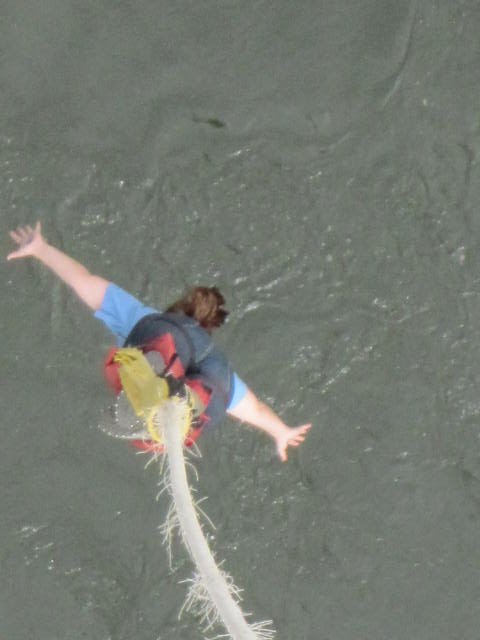


happy to be back on solid ground
We had to wait along time for Dena's bungee video to load before we could watch it on the TV. In the meantime, we had "Bungee Burgers" for lunch. After finally seeing the video, we paid for our DVD with all three segments, and then headed back to Livingstone.
Subscribe to:
Posts (Atom)